Breadcrumb

Workplace safety

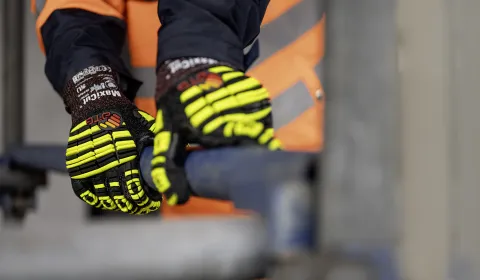
Understanding Impact Resistant Gloves

Impact injuries are a common challenge across industrial and logistics environments, yet many teams rely on PPE specifications that do not always reflect how impact protection is tested or what the ratings truly mean in practice. 

Our new help sheet, Understanding Impact Protection, explains the key differences between EN 388:2016+A1:2018 and ANSI/ISEA 138, two globally recognised standards that take notably different approaches to assessing back-of-hand protection.

For safety managers, specifiers, and anyone selecting gloves for impact-related tasks, understanding these differences is essential to choosing PPE that is fit for purpose and wearable for the full working day.

Download the help sheet to explore the two standards and make confident, informed PPE decisions for your teams.

It is clear, practical, and designed to support better protection without compromising comfort or performance. 

Understanding Impact Protection

Image
MaxiCut® Ultra™

ATG® Supports European Safety and Health Network

The agreement will see both organisations joining together to support OSH professionals across Europe – sharing knowledge and opportunities.

Francesco Santi, President of ENSHPO, says:
“We are delighted that ATG has joined our growing band of ENSHPO supporters. Our shared belief in the importance of caring for the planet and its people will result in exciting opportunities to align and work together.
ENSHPO values our supporters as they bring valuable insights and experience to the benefit of our members. In turn, we are able to offer them reflections from EHS professionals and examples of good practice.”

Chris Busby, Head of Global Strategic Partnerships and Business Unit Manager at ATG, expressed his appreciation for the work of ENSHPO:
“We are thrilled to collaborate with ENSHPO to strengthen our connection with end-users, enhancing our understanding of their needs and demands as a leading PPE manufacturer. ATG is wholly committed to prioritising worker satisfaction through our comfort-first philosophy.
As a fully integrated manufacturer, we are dedicated to sustainability in every aspect of our operations, which also aligns with ENSHPO’s vision.”

To learn more about becoming a supporter of ENSHPO, visit https://www.enshpo.eu.

Image
ENSHPO

ISO Cut Level D Explained

Since the introduction of the revised code standards in 2016 which redefined the coupe standard and saw the introduction of the ISO13997 test a modern-day myth emerged.

Why?

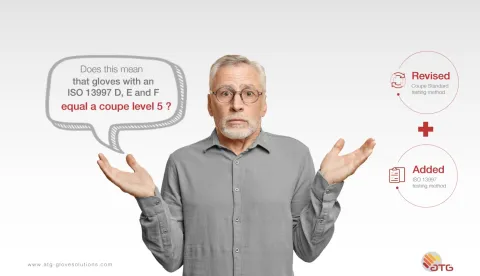
Because much of the industry started making gloves for the new ISO13997 standard and chose to place an X for the coupe standard which led to the assumption that gloves with an ISO13997 D, E and F is a coupe level 5. This is a false assumption. We believe that those involved in the selection of cut protection gloves need to know this, so they can make an informed choice as to the most suitable cut glove.

Do you know why manufacturers put an X for the coupe cut standard?

The coupe test is suitable for repetitive jobs that require precision handling in medium to high cut jobs even though the coupe test remains the most representative test for daily applications in the workplace. The X for coupe means the glove either dulled the blade or not tested by the manufacturer. If you see an X on your glove, ask your supplier what the coupe test result is and be ready to be surprised. If you still need convincing, then look at our market study of some familiar brands.

Our study: market comparison

As part of our continued pursuit of quality we have built a state-of-the-art test laboratory at our 100% owned manufacturing facilities which we use for the testing of each and every batch of gloves before they’re approved for release into the market. Our laboratory is accredited to the exact same standard as the official test houses are accountable i.e.. ISO 17025. The results are presented below.

Manufacturer

Style

Coupe Level (marking)

Coupe Level (tested)

ISO Cut Level (marking)

ISO Cut Level (tested)

A

A1

X

3

C

C

A

A2

X

3

F

F

B

B1

X

3

F

E

C

C1

X

4

E

F

D

D1

X

1 !

C

C

D

D2

X

3

D

D

E

E1

X

4

F

D !

F

F1

X

3

F

F

G

G1

X

2 !

D

D

H

H1

X

3

E

D

Which cut test should I use?

The answer is really simple. It depends on what you are doing. If you’re looking for a glove to use in repetitive jobs handling low to medium weight parts, then look to the coupe test result. However, if your worker(s) faces the risk of a one-off extreme cut from heavy items then ISO 13997 and ANSI/ISEA 105 (2016) are the tests to use.

Is there anything else to consider?

Find out more: www.comfortableperformance.com.

Comfort is the key to compliance

Did you know that 70% of workers who suffer hand injuries were not wearing gloves at the time of their accident. Simply put, gloves can never protect those who don’t wear them, which is why we spend so much time ensuring that comfort is built into all our gloves.

With the introduction of the new ISO 13997 standard and the additions to the ANSI/ISEA 105 standard, which grade gloves from A1 to A9, the race to the top began, even though gloves achieving an ISO 13997 F grade or ANSI A9 grade are purchased by less than 1% of the market. The best intentions can be dangerous, and the number of injuries confirms that. Over the last 10 years workplace injuries have fallen by 25%, BUT hand injuries have almost doubled in that time because the focus has been on using gloves that receive high test scores, i.e. that meet the EN, ISO and ANSI standards, which we call the ‘Cut Protection Paradox’. Don’t forget Comfort is the Key to Compliance which is why we build Comfortable Performance into all we do.

Our MaxiCut® Ultra still marks the benchmark for combining comfort with protection. We call this COMFORTABLE PERFORMANCE.

See our MaxiCut® Ultra™

Image
An ISO cut level D and above is not equal a Coupe level 5

Why Grip Is a Safety Feature

This will, perhaps, be the world’s shortest article, since the answer to that question is yes: grip is indeed the new safety feature. But why is grip able to offer the glove user more safety?

Surely gloves have always had grip, so how can this be a new thing? The answer to these questions is to do with the type of grip, the way it’s delivered and the additional benefits it brings. As any tyre manufacture will tell you, power is nothing without grip. Grip has to be optimised for the surface condition of the road or track and gloves are no different.

Cut resistance

Often the response to recurring cut injuries is to introduce gloves with higher levels of cut resistance. However, increasing the cut resistance often treats the effect, i.e. cuts, rather than the cause of the issue, i.e. movement. After all, it’s the movement of what the hand is holding that frequently cuts the glove. Simply put, if it doesn’t slip then it cannot cut. Used correctly, a glove with a lower cut score and the right level of grip can be as effective, if not more effective than a glove with a higher cut rating and ineffective grip. Using thinner gloves will also increase worker acceptance through better comfort.

IF IT DOESN’T SLIP, IT CANNOT CUT.

John Taylor, Chairman ATG

Worker comfort

Worker comfort is always one of the first things people consider when selecting or trying on a glove. Is it comfortable? Does it offer the needed dexterity, flexibility and tactility? Gloves that offer more cut resistance are frequently more bulky, working against the other metrics. It’s a question of protection versus comfort. It’s fundamental to get this right, since bulky gloves will be taken off for precision-handling tasks leaving bare hands exposed to the risk of a cut. This is why many case studies conclude that using gloves with a higher cut resistance will not necessarily reduce the injury frequency rate (IFR).

Hand fatigue

Have you ever clenched your fist 100 times? If you have, then you’ll know that at the outset it’s easy but towards the end it becomes more difficult. This fatigue is similar to when your hand lifts and holds something over and over again. Why? Because it has to apply force and force needs energy. It’s no different for workers using their hands professionally. With glove grip enhanced by just 5%, the dry lift increases from 24kg (bare hand) to 25.26kg (gloved hand). At ATG®, we like to think of it another way. Rather than being able to lift an extra 1.26kg with an optimized grip, we say that only 2.38kg of force is required to lift 1kg instead of 2.5kg, and these small differences over a working day, week, month and year(s) can make a significant difference.

HAND FATIGUE IS CAUSED BY APPLYING FORCE AND FORCE NEEDS ENERGY

Time for change?

We at ATG® believe so. People have been poorly served and come to accept that coated cut-resistant gloves are PU. We were inspired to develop something totally new within the cut sector based on the core values of MaxiFlex®, creating the world’s first game-changing biomimetic cut-resistant glove, MaxiFlex® Cut™.

Image
Is grip the new safety feature?